
Monday, June 17, 2013
Mountain View Monday # 10
While not a mountain in the typical sense, Mary's Peak in the Coast Range of Oregon is a mountain nonetheless. At just over 4,000 feet high, this small mountain can be seen from the countryside surrounding Albany and Corvallis. While it pales in comparison to Washington's 7,980 foot Mount Olympus, Mary's Peak is the highest mountain in the Coast Range of Oregon. A road takes travelers to the top, where on clear days it is said that a person can see the Cascade Peaks and the Oregon Coast. But with clouds, field burning, and fog, to see either the Cascades or the Oregon Coast is a rare occasion.

Monday, June 10, 2013
Mountain View Monday #9
Near the Willamette Pass and Odell Lake is a volcano known as Diamond Peak. This mountain was first climbed in July 1852 by William Macy and John Diamond. At under 9,000 feet, Diamond Peak is no where close to being one of the tallest in Oregon, but still its 3,000+ foot prominence allows it to stand out as you drive along the Willamette Highway. In the picture below, Diamond Peak is the big mountain on the left. The smaller cones on the right are Mount Yoran.


Sunday, June 2, 2013
Earth Speak Sunday #9
 The Trail by Jonathan Patzer (me)
Walk someplace new,
on a trail through the trees.
Take in the view,
of high mountains or blue seas.
Past a waterfall,
or across a lava flow.
Oregon has it all,
even over deep, powdered snow.
Tuesday, May 28, 2013
Mid-Willamette Explorer is now up
My newest blog, featuring just the mid-Willamette Valley, is now posted. In a magazine format, the June issue is the first to be created. Check the nine articles out at Mid-Willamette Explorer
Native Talk Tuesday #10
The plant featured in today's Native Talk Tuesday is Rododendron macrophyllum,
commonly known as the Pacific Rhododendron. This type of Rhododendron produces pink flowers from May to July, depending on elevation and latitude. Almost all Pacific Rhododendrons in the forests will be scraggly instead of the bushy rhododendrons seen in many yards across the Willamette Valley. This type of plant is found from the coast to middle elevations and range from northern California to the Canadian border.
 Although more widely spread in Oregon, the Pacific Rhododendron is the state flower of Washington. This species of rhododendron readily sprouts after a clear-cut or forest fire, bringing color to cleared or burned areas.
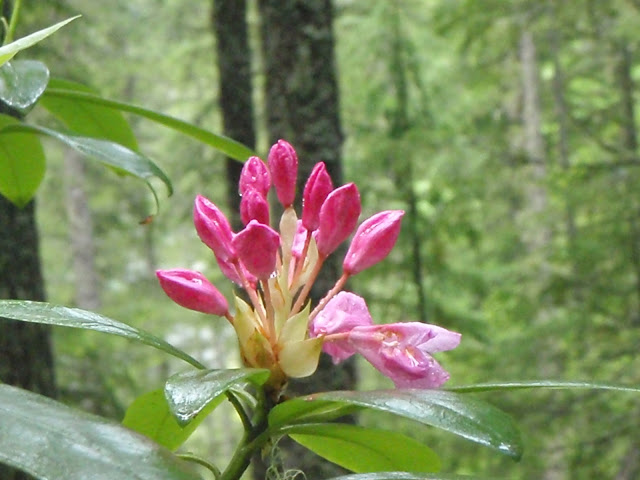

 Although more widely spread in Oregon, the Pacific Rhododendron is the state flower of Washington. This species of rhododendron readily sprouts after a clear-cut or forest fire, bringing color to cleared or burned areas.

Tuesday, May 21, 2013
Native Talk Tuesday #9
The plant featured in today's Native Talk Tuesday is Rosa nutkana,
commonly known as the Nootka Rose. For those that do not know the distinction between this rose and other wild roses, it is also refered to as the Wild Rose. Usually growing to 10 feet high, with soft, straight thorns at the base of each leaflet, this rose can sometimes be seen along the roadsides of the Willamette Valley. The leaflets, which alternate along the branches, contain 5 or 7 serrated leaves. The flowers are differentiated from the Baldhip Rose as they are larger, at 1.5 to 3 inches across. Unlike the Clustered Wild Rose, the Nootka Rose has only one flower at the end of each stem.

The Nootka Rose is often found in a variety of open habitats such as along the streambanks, clearings, meadows, thickets, and along roadsides of the Pacific Northwest from Southern Oregon to Glacier Bay, Alaska; occurring from low to middle elevations. This rose was named after one of several, if not many, native tribes who placed the leaves under and over their food to flavor it and keep it from burning while being cooked. Chewed leaves were applied to bee stings, and although I wouldn't recommend it, a tea made from strips of bark from this plant was used as an eyewash for cataracts or to enhance eyesight.


The Nootka Rose has pink, 5-petal flowers that are up to 3 inches across.
The Nootka Rose is often found in a variety of open habitats such as along the streambanks, clearings, meadows, thickets, and along roadsides of the Pacific Northwest from Southern Oregon to Glacier Bay, Alaska; occurring from low to middle elevations. This rose was named after one of several, if not many, native tribes who placed the leaves under and over their food to flavor it and keep it from burning while being cooked. Chewed leaves were applied to bee stings, and although I wouldn't recommend it, a tea made from strips of bark from this plant was used as an eyewash for cataracts or to enhance eyesight.

The Nootka Rose growing along a country road east of Salem.
Monday, May 20, 2013
Mountain View Monday #8
Across Diamond Lake from the main campground lies a volcano with a rounded top. Due to its gentle slope, compared to other Cascade stratovolcanoes, Mount Bailey is often traveled on in winter. Those who go to snowshoe, ski, or drive a snowmobile over its slopes, usually end up camping at the Diamond Lake resort.
Mount Baily is under 9,000 feet high and was a spiritual place for Native Americans, who were first credited with ascending the mountain. Even today, people still come to hike the mountain in summer.

Mount Baily is under 9,000 feet high and was a spiritual place for Native Americans, who were first credited with ascending the mountain. Even today, people still come to hike the mountain in summer.

Subscribe to:
Posts (Atom)